01One law, two ledgers
Everything below is downstream of one rule, and it is the only rule in the game that can be proved rather than argued about.
Every ton in the game was put in the ground at genesis. From then on it can only move — out of the crust, into a warehouse, into a hold, across a lane, through a factory that changes what it is, and finally into a mouth or a slag heap. It is never minted.
A second ledger says the same of money: credits are minted at genesis and never again. Both are checked by an auditor that rolls every pool in the universe into one column — crusts, warehouses, holds, hull structure, wreck fields, the sink, and the two pools the player stands in — and compares the total. A pool left out of that call reads exactly like a leak, which is the correct failure: forgetting to count a warehouse is losing track of the mass in it.
The check is on the grand total, not per material, because transformation is the whole point of industry. A smelter is supposed to destroy ferrite and create steel. What no process may do is change how many tons there are.
109 ports · 730 simulated days · seed 20260922

  genesis        93,792 kt
  in the crust   85,200 kt
  in warehouses   4,655 kt
  afloat in holds    36 kt
  consumed/slag   3,801 kt
  ---
  mass           BALANCED at every checkpoint, every seed
  credits        BALANCED — 123,082,138 cr, every one in a purse
02The menus
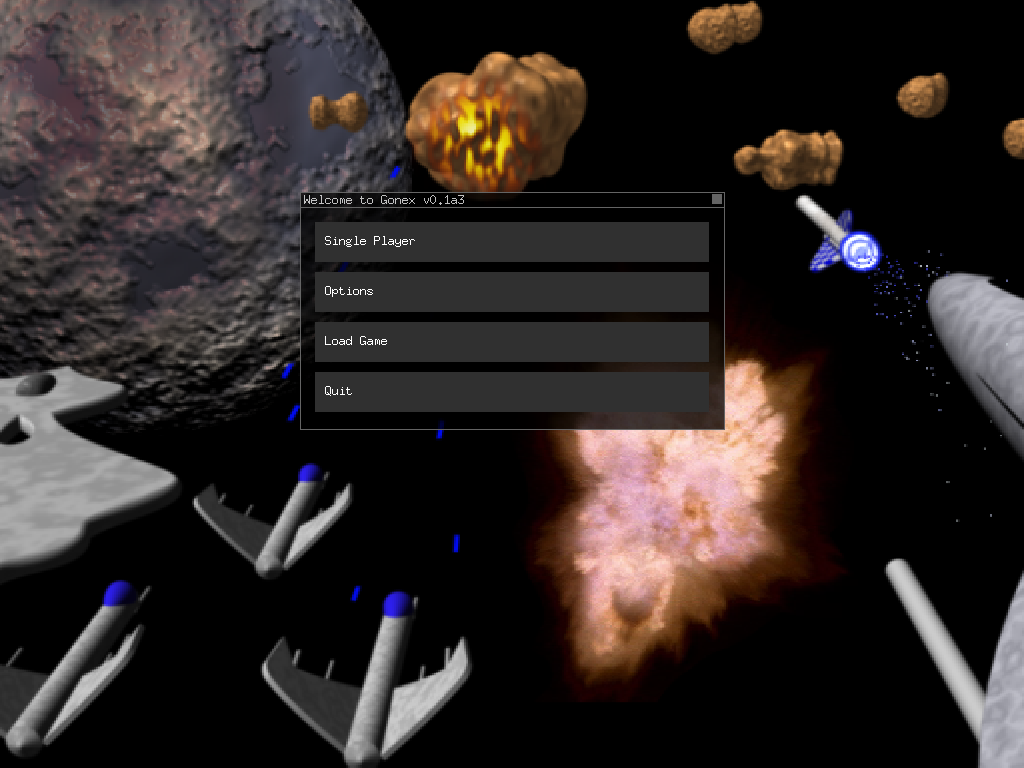
The menu tree is konex's, kept deliberately: single player with three modes, options for display and player, and the save/load pair. Trader is the mode this project added — the commodity game with the reentry landing under it.
03Flight, war and the map
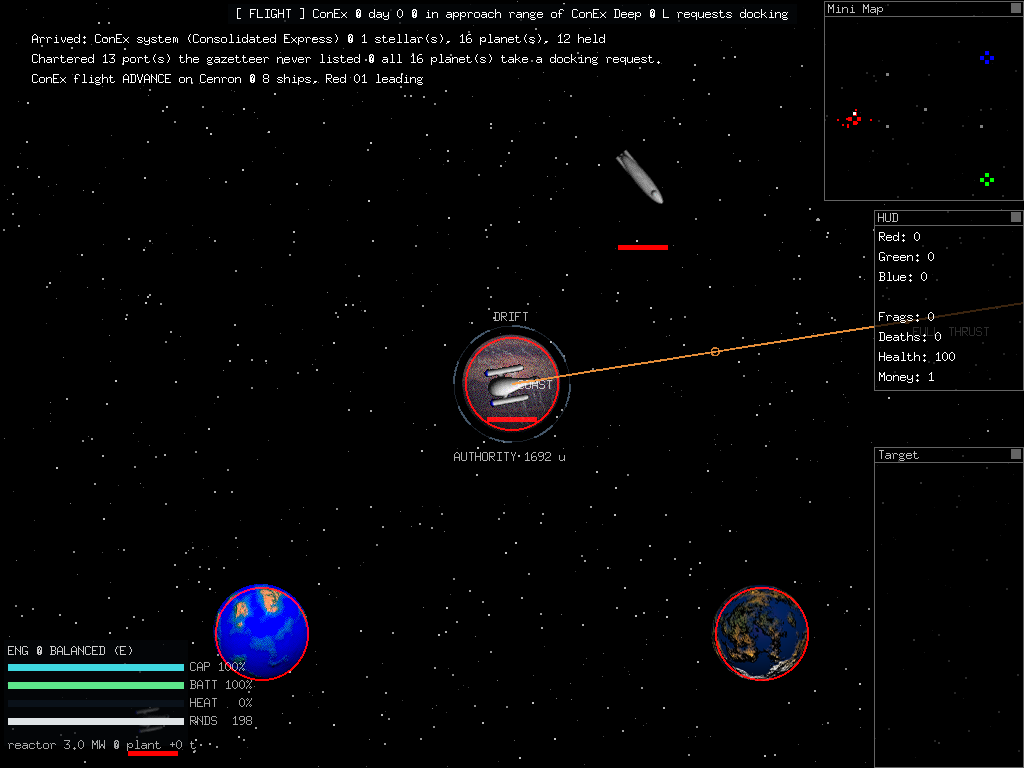
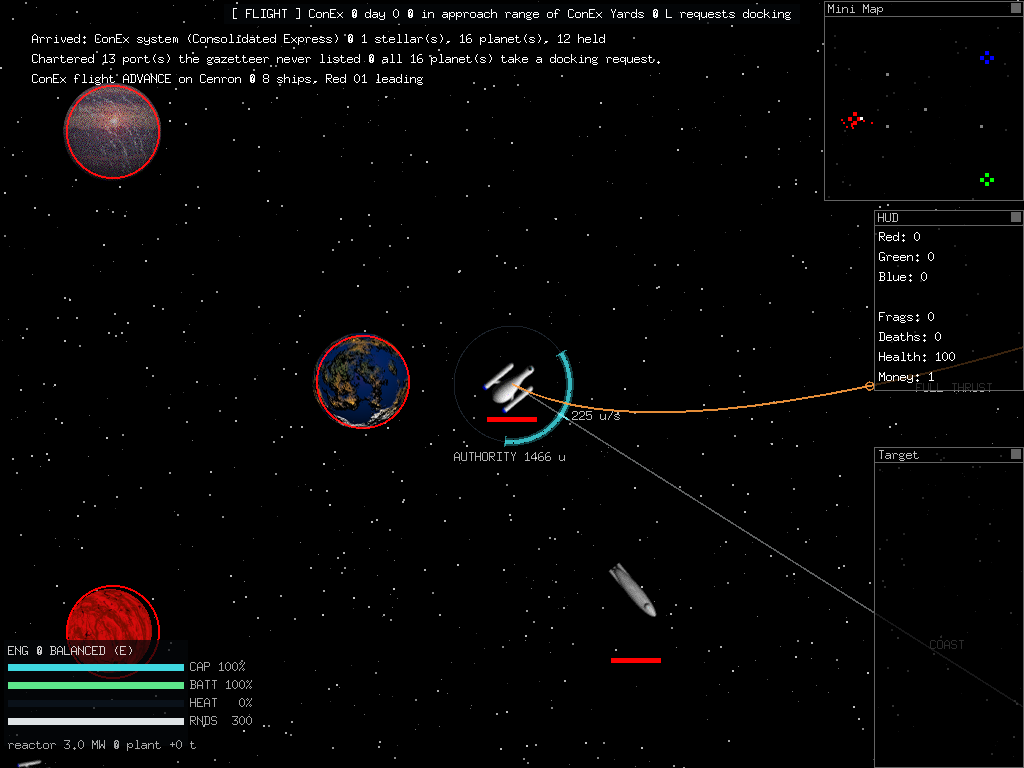
The flight view is konex's top-down arena, unchanged in feel: arrows turn and
thrust, space fires, X brakes, Shift targets the nearest enemy. What changed is
what the other ships are doing there.
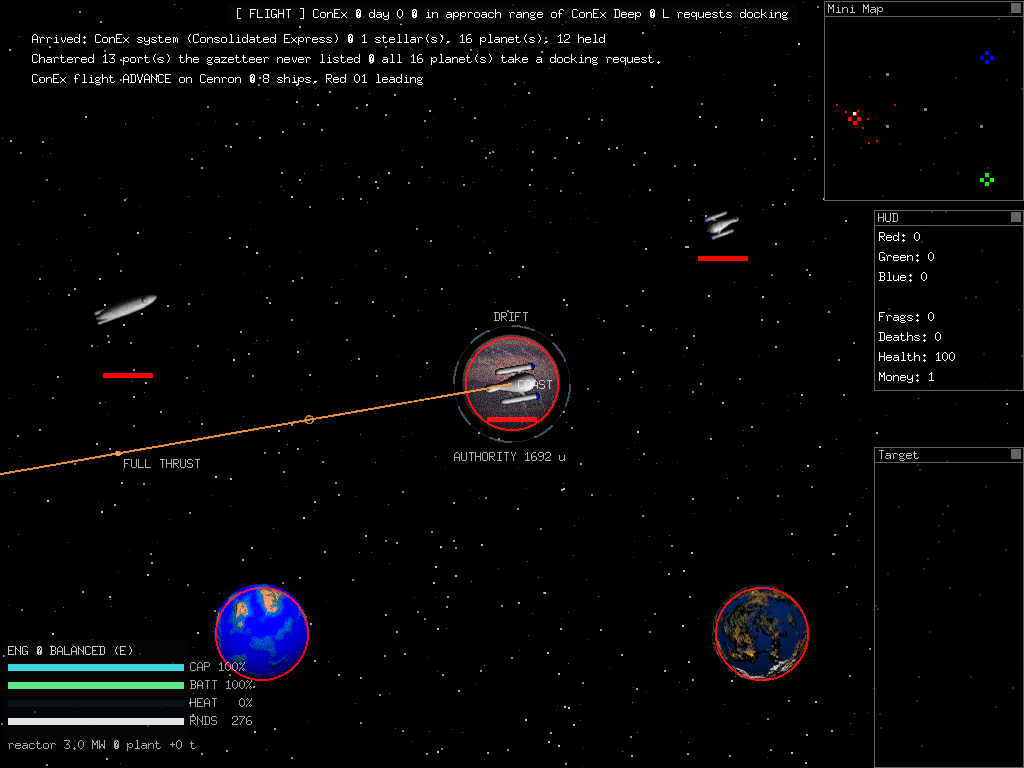
L near a planet requests clearance.
arrows · space fire · X brake · Shift target · Ctrl autotarget · Tab map · L land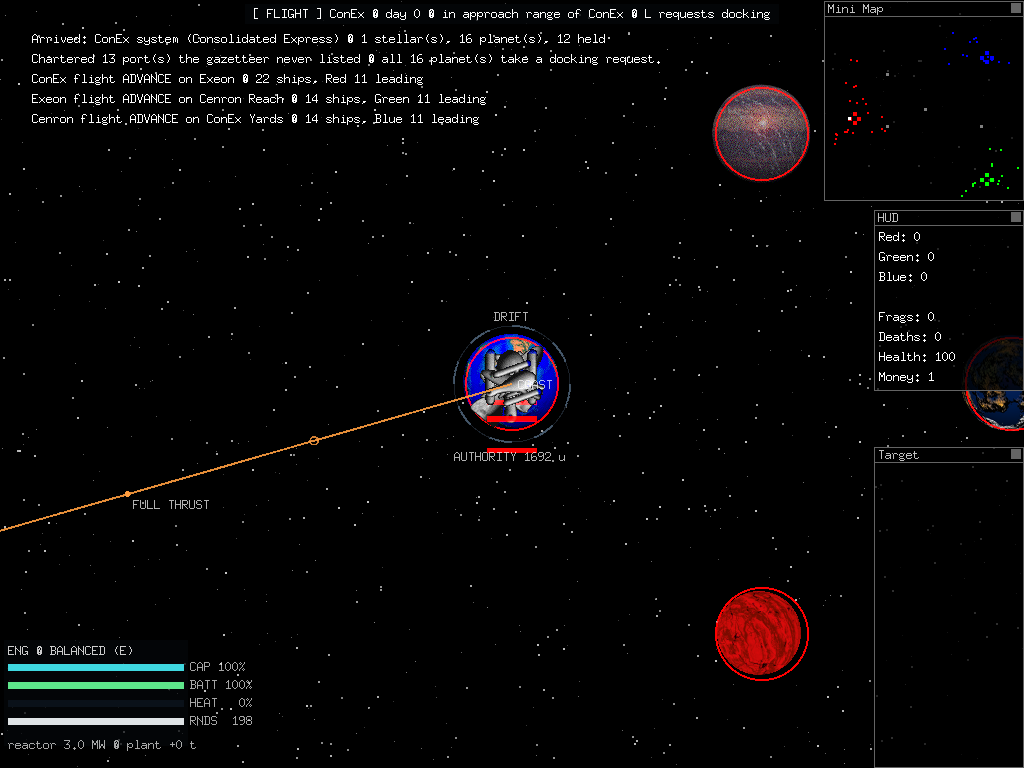
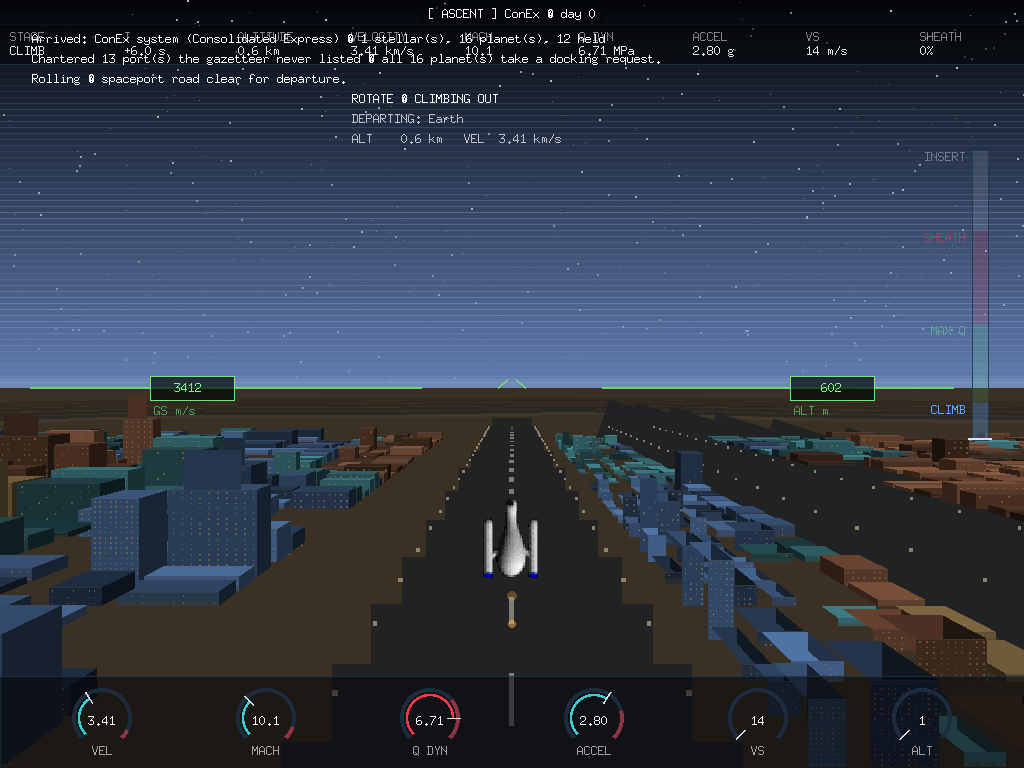
04The voyage: warp, deorbit, reentry, takeoff
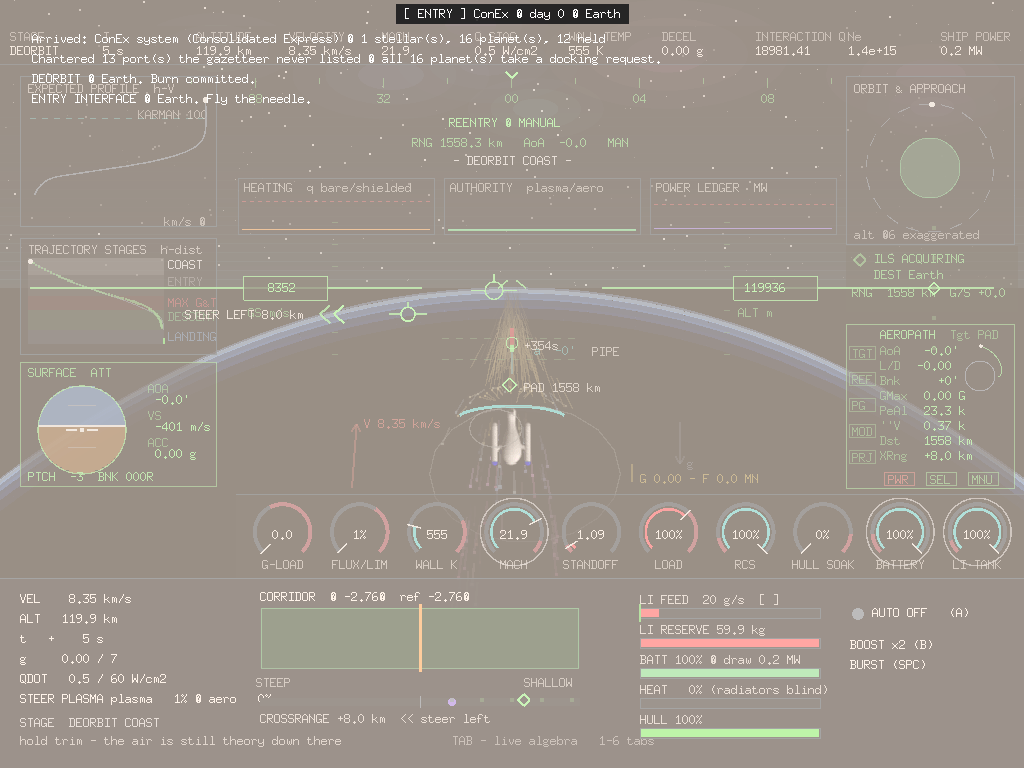
Getting to a planet's surface is four screens and about a minute of flying. Each is a real phase of the same trajectory rather than a transition.
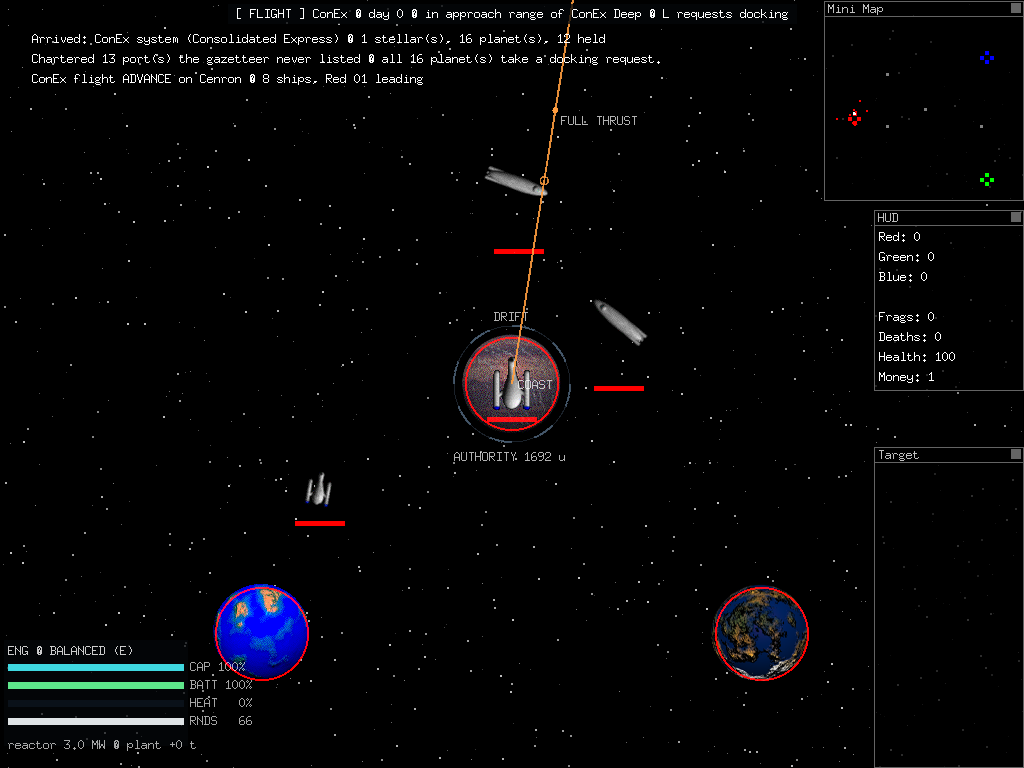
The reentry corridor
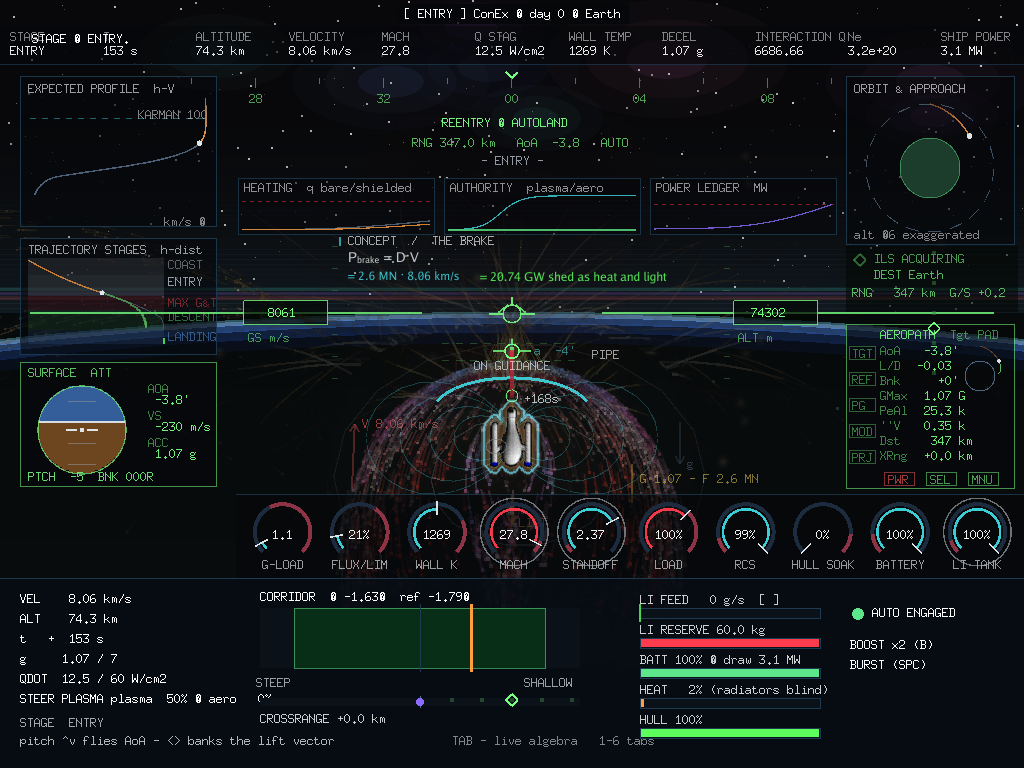
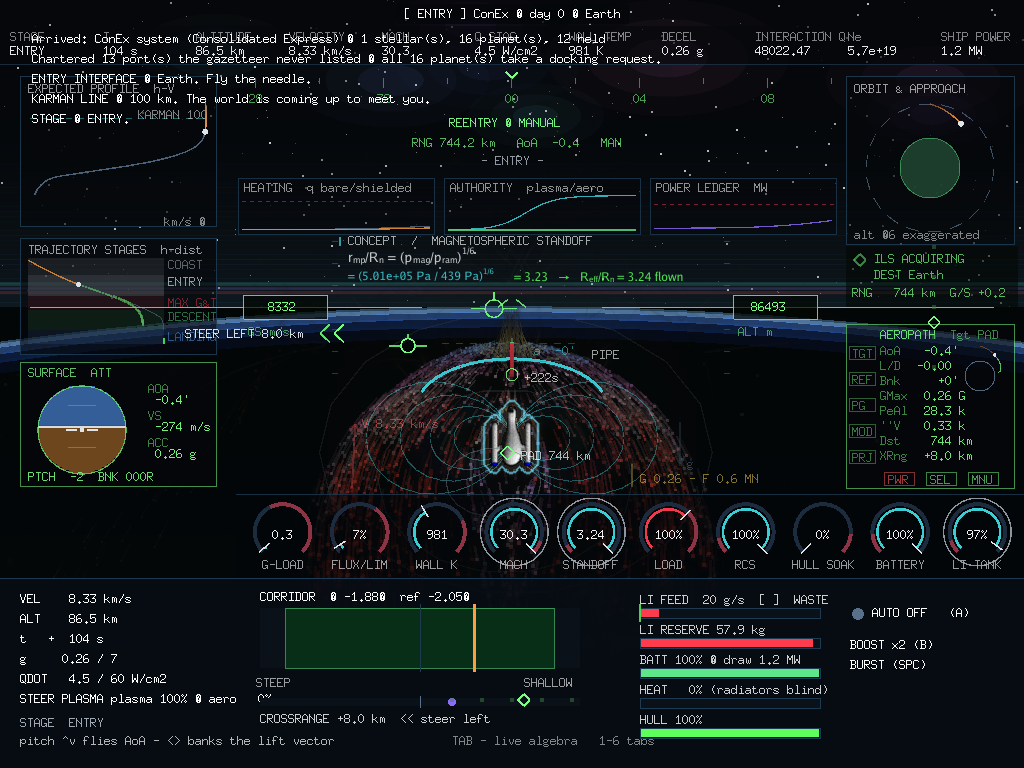
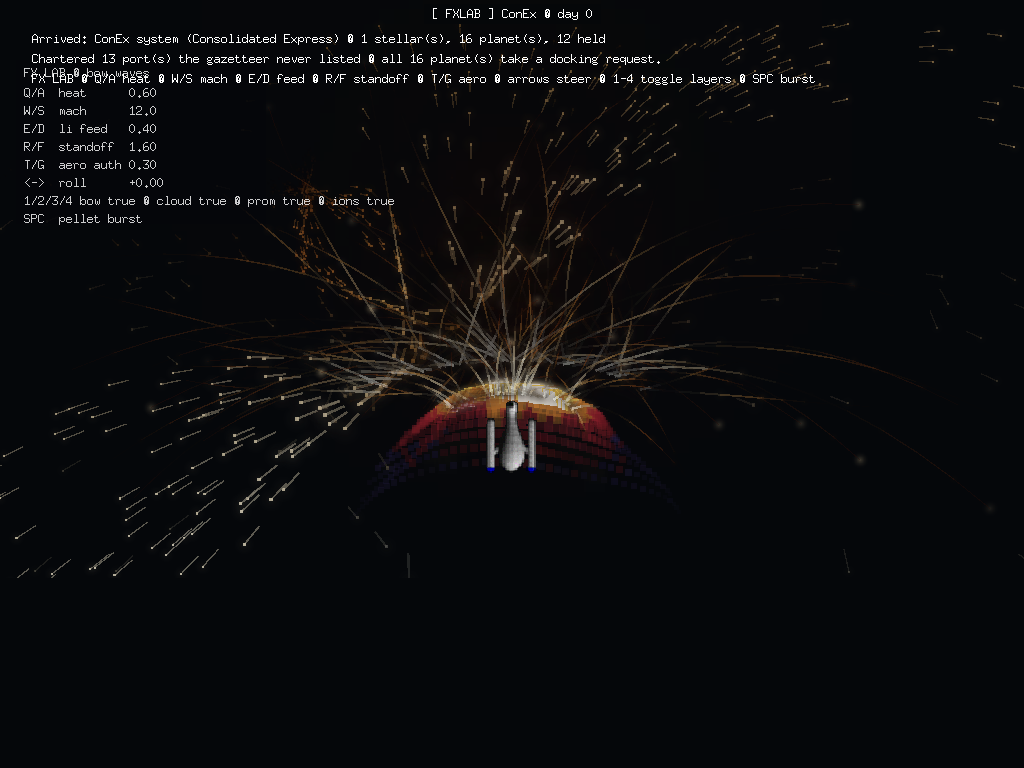
This is the piece the project is really about, and the screen with the most physics in it. A 350-tonne freighter has the ballistic coefficient of a falling anvil; what makes it flyable is an MHD plasma aeroshell — a magnetic bubble inflated ahead of the nose that stands the shock off and sheds the heat.
05The concourse and its six screens
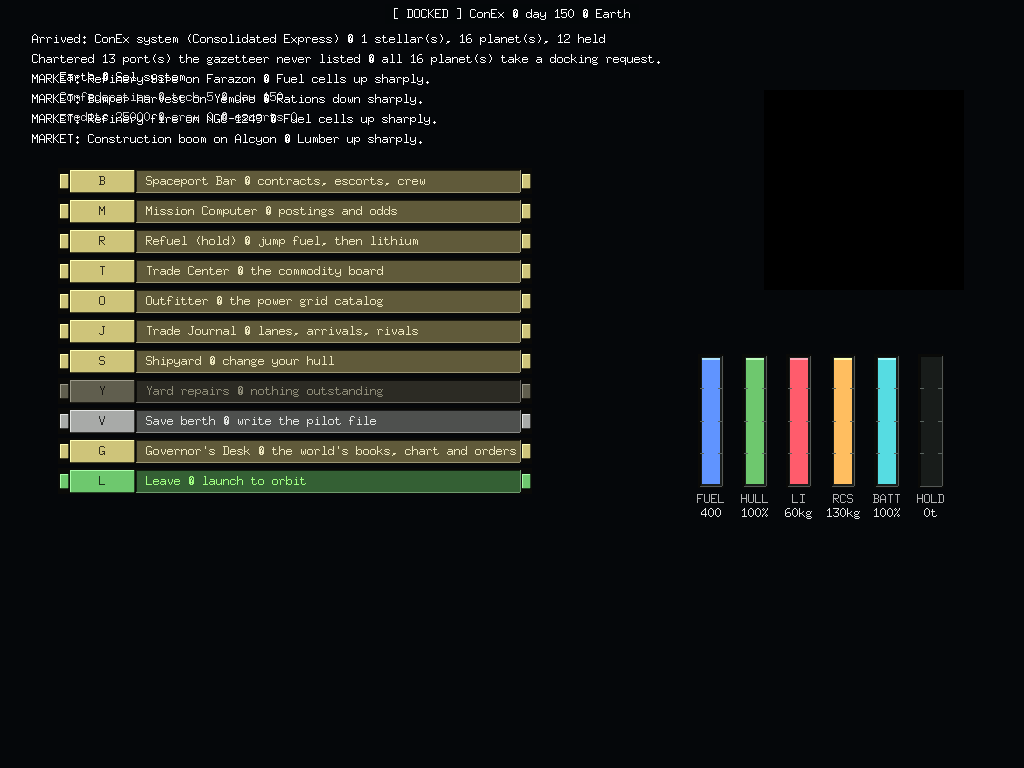
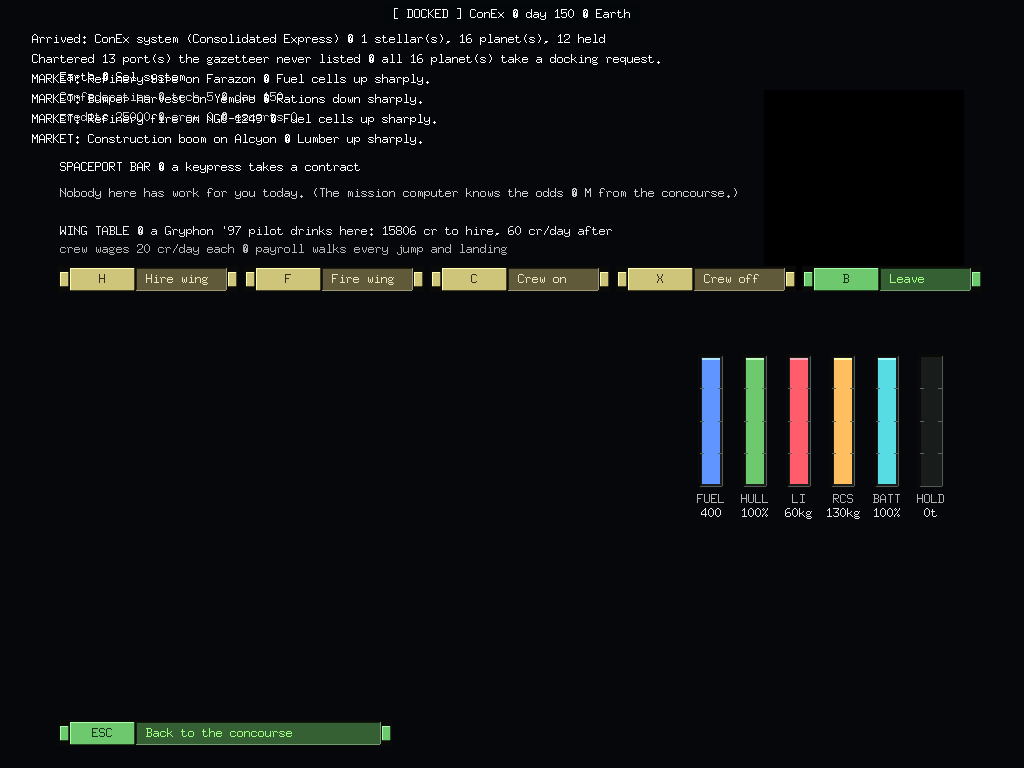
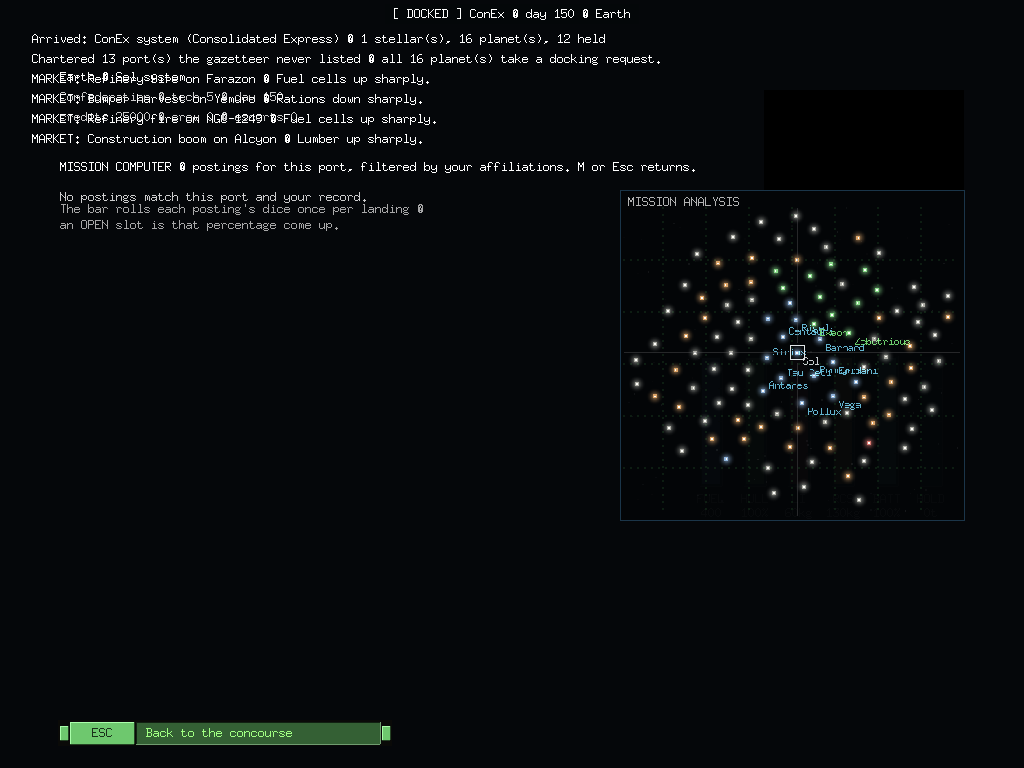
Landing ends on the concourse. Six sub-screens hang off it, and Esc
from any of them returns here rather than opening the game menu.
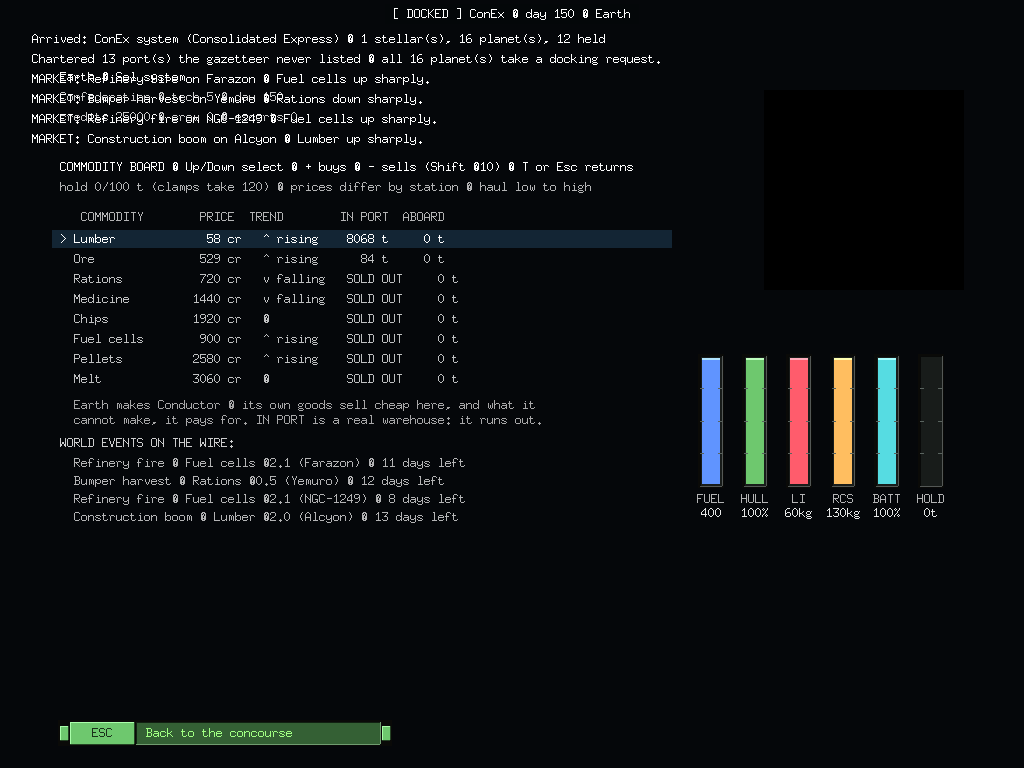
SOLD OUT. That is the fuel famine, visible at a counter.
up/down select · + buys · − sells · Shift ×10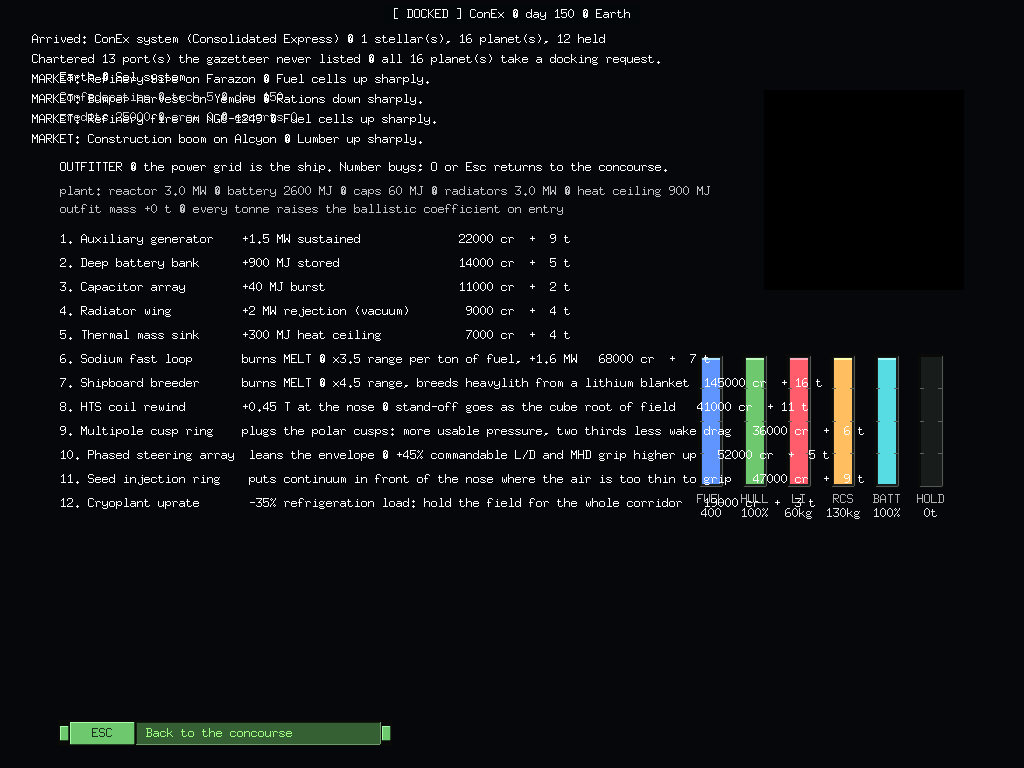
06The Governor's Desk — four tabs
G at any dock. If you bought the first building at a world you hold its
charter and the desk is writable; otherwise it is read-only and you are
watching somebody else govern.
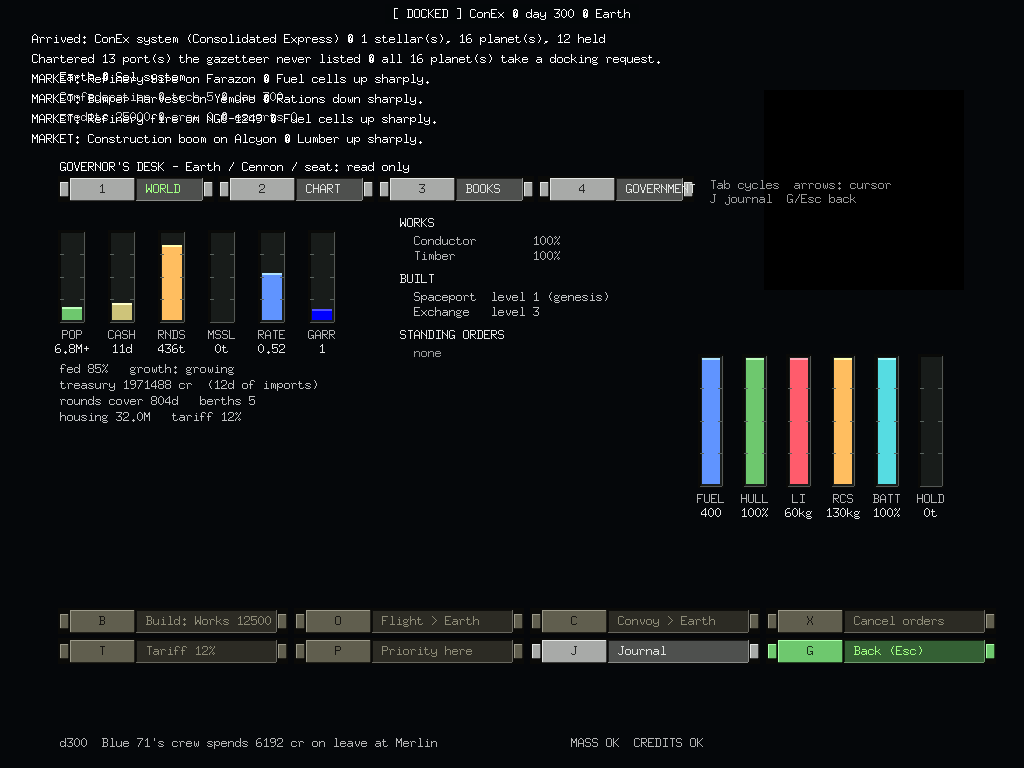
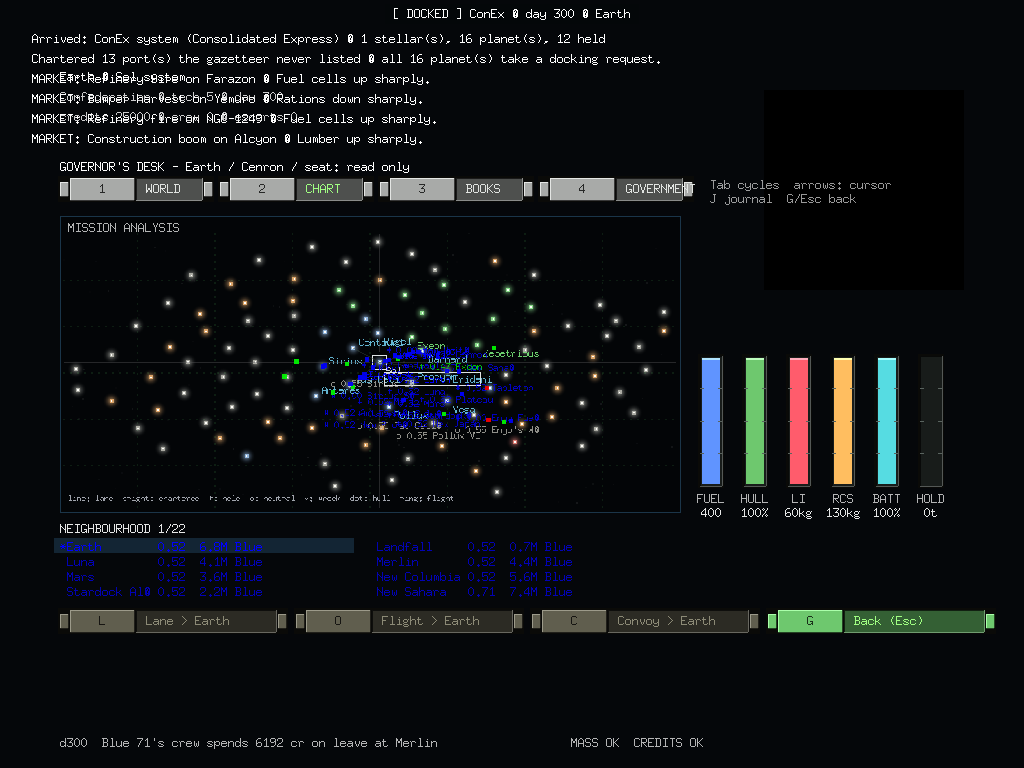
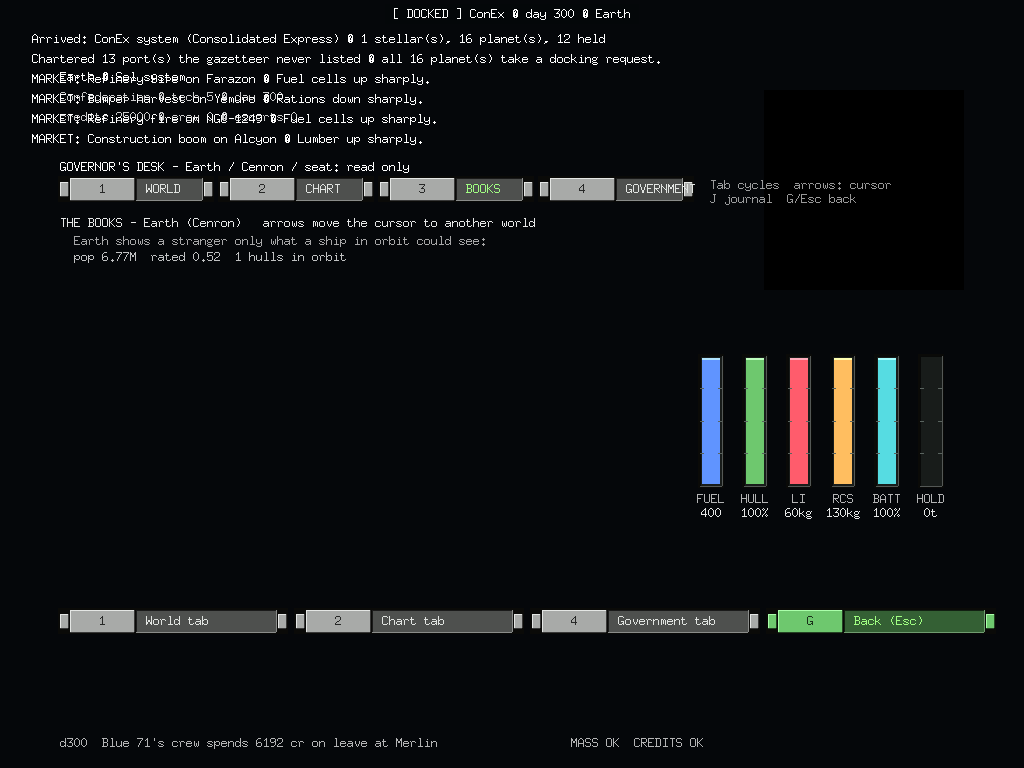
MASS OK CREDITS OK — the conservation proof,
on screen, every frame.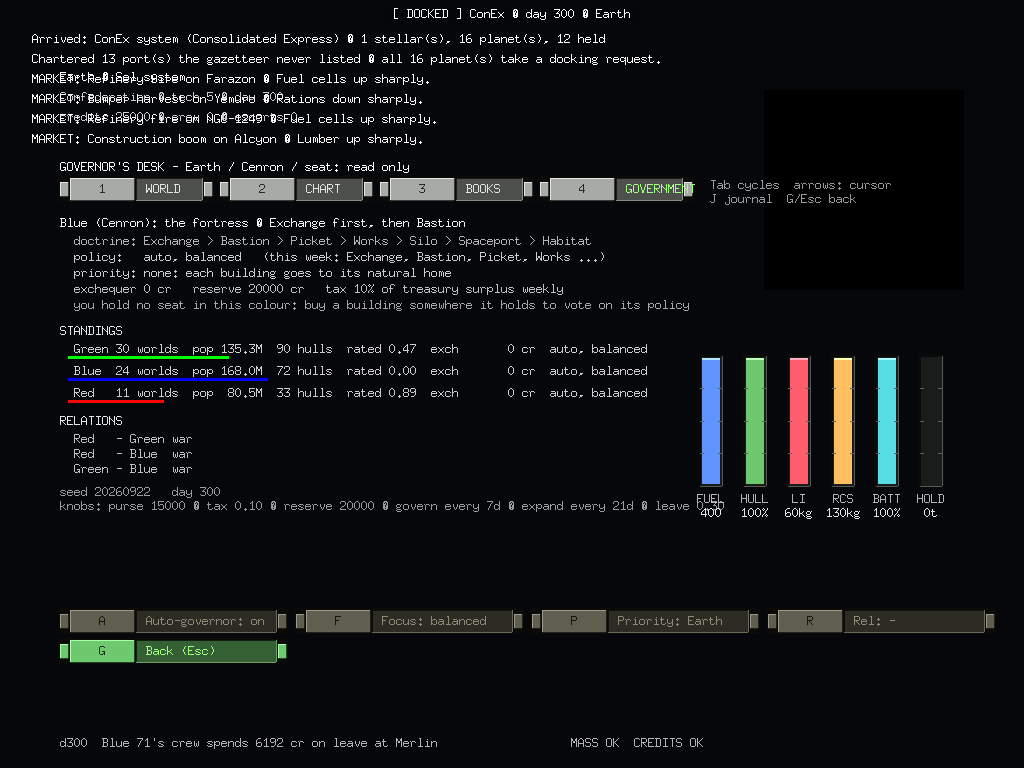
07The zero-sum economy
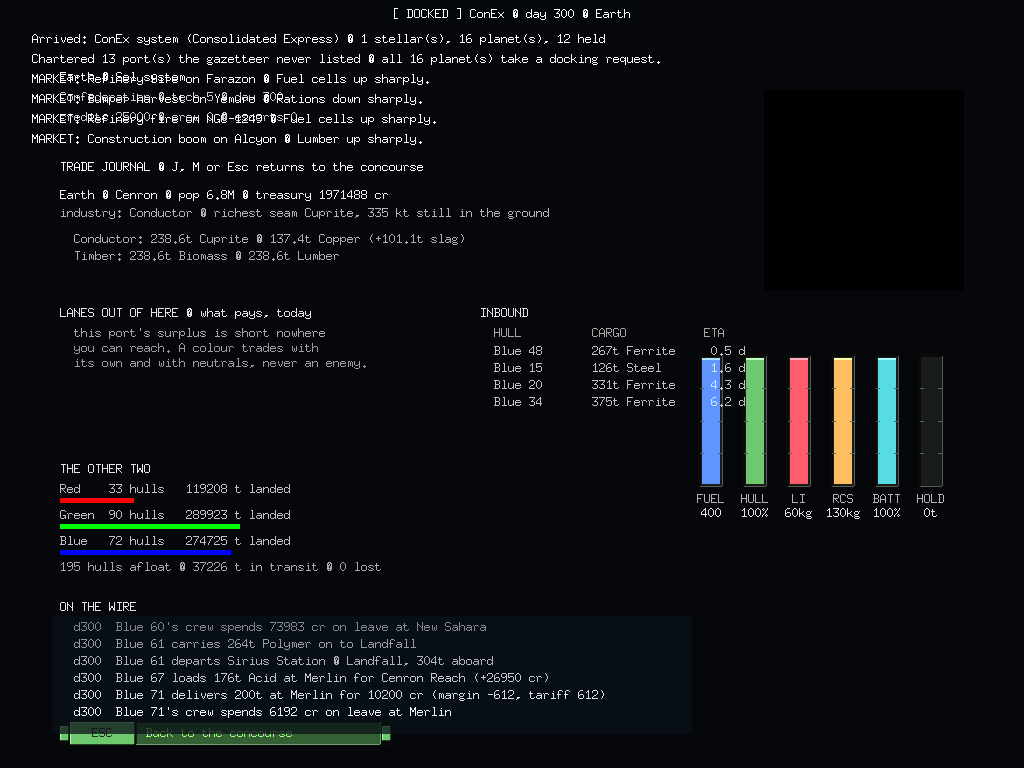
Under every screen above there is a simulation of everywhere: 109 ports digging, refining, eating, growing and trading, with roughly 195 hulls carrying the difference between them. It runs whether you are looking at it or not, and landing burns days — so a long delivery comes back to a market that has moved.
Matter: 30 materials in six tiers
The ordering is load-bearing in exactly one place: the first eight entries are the commodity board, in order, so a planet's warehouse and a ship's hold are a prefix of a full material vector and convert by copying.
| Tier | Materials | Rule |
|---|---|---|
| Board (8) | Lumber · Ore · Rations · Medicine · Chips · Fuel cells · Pellets · Melt | what a port posts a price for, and all the player trades |
| Refined (10) | Steel · Copper · Silicon · Polymer · Grain · Lithex · Lithium · Heavylith · Acid · Fluid | made, not sold; what a smelter hands a fabricator |
| Yard (3) | Hull · Rounds · Missiles | what a fleet is made of and what it shoots |
| Returns (2) | Compost · Scrap | the only two places the flow goes back uphill |
| Crust (6) | Ferrite · Cuprite · Silicate · Volatiles · Biomass · Spodumene | finite; the only tier mining can produce |
| Sink (1) | Slag | counted, and worthless — which is what makes the books balance |
Two predicates carry the travel rules, for two quite different reasons. Hot — pure lithium and heavylith travel in a shielded cask or not at all, because a cask that survives a jump costs more than the ton inside it, which is what pins the finishing plant beside the breeder rather than beside the customer. Bulkable — steel, concentrate, acid and hydraulic fluid are refined but ship like goods, because a city eats steel and the hot worlds import chemicals or run nothing.
Mass flow, every branch
Mass only ever flows left to right, except at the two return loops. The crust is the only source and it is finite; slag is the only grave. Everything in between is a change of identity at constant tonnage.
Industry by composition
Seventeen chains are built from twenty-three primitives by one operator:
func (m *Module) Then(next *Module) *Module
Plug m's outputs into next's inputs; get back a module whose ports are
whatever the pair could not satisfy internally. Because the result is itself a
module, it plugs into a third the same way — a supermodule is not a special
kind of thing with its own rules, it is a module that remembers what it was
built from.
Two properties, both tested: mass balances, and the chain runs at its bottleneck, recorded at composition time because that is the only moment the shortfall is visible. And nobody authored a speciality — a world ranks the chains its own rocks could back and stands up the best two. A world that can smelt and fabricate has a chip industry; nobody wrote "chip industry" down.
The lithium cycle
Fuel is radioactive heavy lithium, and it comes off a five-stage line in two forms that are not interchangeable. Which one a hull can burn is a question about the reactor bolted into it — so the reactor decides which refineries in the galaxy are your suppliers.
One tonne of spodumene is about 0.13 t of finished fuel across the whole line. The waste is slag and it is counted.
Hostile worlds
A world's radiological dose and its spodumene seam are drawn from one number — the single place in the game where two facts about a world are forced to be the same fact. A clean world has no spodumene at all, however rich it is otherwise; a hot world's reserve scales with exactly how hot it is.
| clean | milling ≥0.10 | smelting ≥0.35 | breeding ≥0.55 | |
|---|---|---|---|---|
| population ceiling | 32 M | ~1.35 M | ~975 k | ~675 k → 40 k |
| growth | full | taxed up to 94 % | ||
| licensed line | — | Lithium milling | Radiant smelting | Fuel pellets / melt |
| worked by | a workforce | machines — dose that stops a city does not stop a machine | ||
| flag | a polity | whoever is paying — the free ports of the fuel trade | ||
Why a refinery is founded with money
A licensed world opens with working capital sized to its own line. Without it the hot worlds sit in a trap with no exit from inside: no chemicals → no fuel → no revenue → no chemicals. A port buys only what its treasury covers, so a broke world does not send a distress signal — it quietly declines the cargo and the courier flies on. One refinery ran a 63 t/day line at 9 % of capacity for a simulated year and nothing anywhere said why.
Prices as scarcity
Price is cover: how many days of real demand the warehouse holds. A short world pays up to 3×, a glutted one as little as 0.35×, and a producer sells cheap — which is what a producer is, and what gives a route its direction.
Two steepenings, each with an argument. Rations, ×7 — people will pay anything for the next meal, which turns a famine into the best-paying route on the board and gets it relieved without anybody scripting relief. A sited world's feedstock, ×5 — a refinery short of acid is not inconvenienced, it is shut.
And every finished good has an appetite, which is not decoration. The first cut gave chips, ore and steel no consumer, so they piled up in warehouses nobody would ever need them from and the whole network went quiet on day 104 with every hull idle. A commodity with no sink stops being traded the moment the first warehouse fills.
The trade loop
The order is the causal order and it matters: you cannot refine ore you have not dug, sell goods you have not made, or route a hull to a shortage this morning's production just filled.
Five kinds of agent
| Mission | What it does | Why it exists |
|---|---|---|
| Courier | free trade, routed by what pays today | the baseline |
| Convoy | a standing order to carry a named material A → B | a government overriding the market |
| Flight | moves hulls; arriving hostile it fights, friendly it garrisons, at peace it turns back | Konquest's war, conserved |
| Harvester | flies empty to a seam, lifts crust straight out of the ground into its hold against a royalty, carries it to the nearest port that wants it | a rich rock with nobody on it produced nothing, for ever — mining was capped by population |
| Survey | carries nothing, earns nothing; reads a seam and leaves. +45 % dig for 90 days where it lands, +20 % one jump out | the only thing that raises extraction without raising population |
And the merchant fleet sizes itself. It opens proportional to worlds held — a trade network's size is a property of the map, not a constant somebody typed — and then every day each colour measures berth pressure, the unserved margin still on its board per hull afloat. Above 90 k cr/hull a yard presses plate; below 22 k it breaks a ship up and puts the tonnage back on the shelf. Nothing is minted: growth costs somebody a warehouse.
08Reentry physics
The magnetopause
The envelope the ship flies behind is not a heat shield, it is a magnetic
bubble. The coil's dipole pushes outward with magnetic pressure; the oncoming
flow pushes inward with ram pressure; and the stand-off is where they balance.
Because a dipole falls off as r⁻³, its pressure falls as r⁻⁶:
r_mp / R_n = ( p_mag / p_flow ) ^ 1/6 p_mag = B²/2μ₀
A bare dipole is not a closed bottle. It has two axial cusps where the field lines run into the vehicle and flow funnels straight down them onto the nose — which is what the multipole ring is for.
The confinement ladder
Nobody buys their way out of that exponent. To stand a shock off twice as far you need sixty-four times the magnetic pressure. What a yard can sell is a fix for one of four distinct ways the balance goes wrong — and each is a different piece of hardware because each is a different piece of physics.
| Failure mode | Outfit | The hook |
|---|---|---|
| the field is too weak | HTS coil rewind +0.45 T | stand-off ∝ B^⅓ — honest, expensive, diminishing |
| the bottle leaks at the poles | Multipole cusp ring | plugs the cusps: more usable pressure, and two thirds less wake drag, which is where it really earns its price |
| the pillow is symmetric | Phased steering array | drives current asymmetrically and leans the envelope: +45 % commandable L/D, and MHD grip several km higher. Paid for on the power ledger |
| the air is too thin to grip | Seed injection ring | MHD needs a conducting continuum; high up there is nothing to push against however hard you push. Put the mass there yourself — inertial confinement, the only rung that works where the magnetic ones do not |
That fourth rung is tested by the property that justifies it: at 88 km the injection ring beats tripling the coil, because tripling a field that has nothing to grip buys nothing at all.
09Ship reactors
A tonne of heavy lithium carries the same energy wherever it is loaded. What decides how much of it a ship can use is the machine it is loaded into.
| Class | Takes | Burnup | Range | Breeds | Mass |
|---|---|---|---|---|---|
| Thermal pile — light-water moderated | Pellets | 5.5 % | ×1.0 | — | stock |
| Sodium fast loop — unmoderated, molten salt | Melt | 19.5 % | ×3.5 | — | +7 t |
| Shipboard breeder — fast loop + fertile blanket | Melt | 25.0 % | ×4.5 | 0.35 t/t | +16 t |
The breeder is the third uphill loop in the game: it burns its charge and transmutes fertile lithium from a blanket it is carrying into fresh fissile material. It does not mint anything — the tonnage comes out of the blanket — which is precisely the distinction the books care about.
Not yet wired partial
Pellets and Melt are traded, priced and eaten by populations, but a hull's own jump does not burn them yet. Until it does, the range multiplier above is a shop label rather than a constraint you feel. It is the highest-value small piece of work outstanding.
10Measured state
Full gazetteer, 109 ports, 730 simulated days, three seeds. The mechanics work; the balance does not, and the numbers say exactly where.
| Measure | Measured | Should be |
|---|---|---|
| Pellets made | 7.6 t/d | 443 t/d of appetite — 2 % |
| Melt made | 23.3 t/d | 286 t/d of appetite — 8 % |
| Chips made | 60.7 t/d | ~815 t/d of appetite |
| Hull plate pressed | 0.0 t/d | enough to replace losses |
| Shipyards in the galaxy | 3 | more than 3 |
| Berth pressure | 5,795–8,406 k | threshold is 90 k — 64–93× over, and it cannot fire |
| Mass & credits | BALANCED | ✓ every checkpoint, every seed |
One causal chain explains all six broken rows:
one world per system  →  copper is a one-jump good with nowhere to go
                      →  chips at 7% of demand
                      →  shipyards at 0% (chips are 15% of the yard recipe)
                      →  no hull plate
                      →  the fleet cannot grow however hard the board pays
                      →  too few hulls to fly acid to 15 scattered refineries
                      →  fuel at 2% of demand
Everything downstream of the first line is a symptom. Three bodies per system — one planet, one station, one nebula or asteroid field — is not a content item; it is the fix for the economy's only structural fault. Nothing above is a correctness bug. It is a map that cannot support the economy standing on it.
11Developer screens
The drop-down console (`) carries the economy: economy, routes,
journal, world <id>, trifecta, standings, day <n>, govern,
doctrine, priority, policy, tune, seed, plus konex's originals.
GONEX_CMD="day 200;economy" runs them at boot and GONEX_SEED reproduces a
universe exactly.
12What needs art
Everything in the game today is either konex's art, art recovered from the 1997 plugin, or drawn procedurally at runtime. Nothing added in the last two passes has a sprite. Here is the honest inventory.
What exists
| Asset | Count | Source |
|---|---|---|
| Ship sprite banks (rotations, target, yard, comm art) | 22 | konex + 9 recovered 1997 banks |
| Planet discs | 18 | konex |
| Explosion frames | 17 | konex |
Pickup items — health, money | 2 | konex |
| Landing views (CustPic) | 13 | recovered 1997 |
| Spaceport metropolis, plasma, shock, field lines, gauges | — | procedural, per seed |
Commodity icons none exist
The eight board goods need to be legible at ~16 px in a list and ~32 px on the board. The two fuels are the important pair — the whole reactor decision hangs on telling them apart at a glance, so they should differ in silhouette, not just colour: a clad cylinder versus a flask of liquid.
| Icon | Reads as | Note |
|---|---|---|
| Lumber | stacked timber | |
| Ore | crushed rock, bulk | the cheapest thing on the board |
| Rations | sealed tin / pack | the famine commodity — needs to read as food instantly |
| Medicine | ampoule / cross | luxury tier |
| Chips | wafer / die | luxury tier; the galaxy's scarcest good |
| Fuel cells | stacked cells | the old fuel — must not be confused with the two below |
| Pellets | clad cylinder, radiation trefoil | solid fuel · thermal piles |
| Melt | sealed flask, glowing liquid | liquid fuel · fast loops |
Deeper material icons none exist
Twenty-two more, needed wherever the desk, journal and industry lines show a material: Steel · Copper · Silicon · Polymer · Grain · Lithex · Lithium · Heavylith · Acid · Fluid · Hull · Rounds · Missiles · Compost · Scrap · Ferrite · Cuprite · Silicate · Volatiles · Biomass · Spodumene · Slag. These can be a tighter, more schematic set than the board icons — a 12 px glyph beside a number, not a picture.
Three want a shared visual language because they are one chain: Lithex (dusty concentrate) → Lithium (bright metal) → Heavylith (the same metal, hotter) — ideally the same silhouette escalating in glow, with Spodumene as the raw ore that starts it.
Outfit icons none exist
Twelve shelf items, of which seven are new. The two ladders should read as ladders — a viewer should see at a glance that a breeder is above a fast loop, and that the four confinement rungs are siblings rather than a sequence.
| Group | Items |
|---|---|
| Power grid | Auxiliary generator · Deep battery bank · Capacitor array · Radiator wing · Thermal mass sink |
| Reactor ladder | Thermal pile (stock) · Sodium fast loop · Shipboard breeder |
| Confinement ladder | HTS coil rewind · Multipole cusp ring · Phased steering array · Seed injection ring · Cryoplant uprate |
Building icons none exist
Eight, for the Governor's Desk and the world tab: Spaceport · Works · Habitat · Exchange · Lane · Bastion · Picket · Silo. Each needs a level indicator (1–3) and a "genesis" state that reads as not bought.
Agent markers none exist
Five mission states want distinct markers on the chart and in the journal: Courier · Convoy · Flight · Harvester · Survey. Harvester and Survey are the two nobody has seen before and most need explaining visually — one is a ship working a rock, the other is a ship doing nothing visible at all.
New body types nothing exists
The planned three-bodies-per-system map needs two entirely new classes of landable object, and they have no art of any kind:
| Body | Needs | Economic role |
|---|---|---|
| Space station | orbital disc/silhouette at flight scale, an approach view, and a landed concourse backdrop that is plainly not a planet | pure sink — population, no crust, imports everything |
| Nebula / asteroid field | a volumetric or particle field at flight scale, plus an ice-crystal cavern interior for the landed view | pure source — crust, no population; worked by harvesters |
| Hostile-world overlay | a dose indicator on the planet disc and on the chart — the 14–22 % of worlds that are refineries should be visible as hostile | the fuel industry's whole geography |
Animations none exist
Stand-in loops would do for all of these; the point is that several important events currently happen with no visual at all.
- Hyperjump — entering and leaving the tunnel (the tunnel itself exists)
- Harvester working a seam — the only mining the player can watch
- Scoop — a hull lifting a wreck field, currently silent
- Refinery plume — a hot world under load, so a fuel world looks like one
- Commission / lay-up — plate leaving or returning to a yard
- Transmutation core design only — laser implosion and the arc field
Known visual bugs visible in the captures above
- Notification overprint. The
MARKET:lines at the top of every docked screen draw on top of each other — visible in nearly every screenshot on this page. They need a proper stacked queue with expiry. - Outfitter runs under the gauges. The new reactor and confinement rows have longer descriptions than the original five, and the text now passes beneath the fuel/hull/LI gauge cluster. The list needs a width budget or the gauges need to move.
- Chart label collision. On the desk's CHART tab, system names in the dense core overlap into illegibility. Needs label de-confliction or zoom.
13The lab reports
Everything on this page is derived from four dated engineering write-ups. They carry the arguments, the measurements, and the faults found along the way.
| Report | What it covers | |
|---|---|---|
| Game mechanics overview | Every mechanic, the rule that defines it, and the test that fails if it stops being true — 56 cited tests, all of which exist and pass | built |
| The lithium fuel cycle | The build, the measurements over three seeds of the full gazetteer, and the eleven faults flying it turned up | built |
| The transmutation core | The nuclide chart read as a price list, the barium line where the Coulomb term overtakes binding energy, lithium as a charged battery made of matter | design |
| The resource cycle · The trade economy · The war economy | The three earlier plans this economy was built on | built |
14What comes next
- Three bodies per system. The unlock. Source, mixed and sink in every system, connected by 60 Mm shuttle hops instead of 240 Mm jumps — which is what the same-type rule was written for and has never once been true.
- The field fills the planet's holes. Draw each asteroid field's crust from the inverse of its planet's barren mask, so every system can complete at least one chain locally while still trading for the finished goods.
- Fuel as a jump consumable, so the reactor ladder is a constraint rather than a label.
- The commodity detail screen — agents on mission, prices within N jumps, best-paying run from here. The data is all computed already.
- The art above.